
The future of remote work no longer looks like a simple battle between home and office. In 2026, both sides appear to be winning different parts of the argument. Large employers keep announcing stricter office rules. Yet millions of people still work remotely, hybrid schedules remain stable, and flexible roles continue to attract fierce interest. The real shift is more complicated and far more interesting: remote work has moved from a mass workplace experiment into a selective, skill-driven system.
That makes 2026 a turning point. Flexibility still exists, but workers cannot assume every knowledge job will offer it. Companies now treat location as a hiring lever, a retention tool, and sometimes a test of control. Employees, meanwhile, treat flexibility as part of compensation.
The 2026 reality in four numbers
- 26% of paid full workdays in the United States took place at home in July 2026.
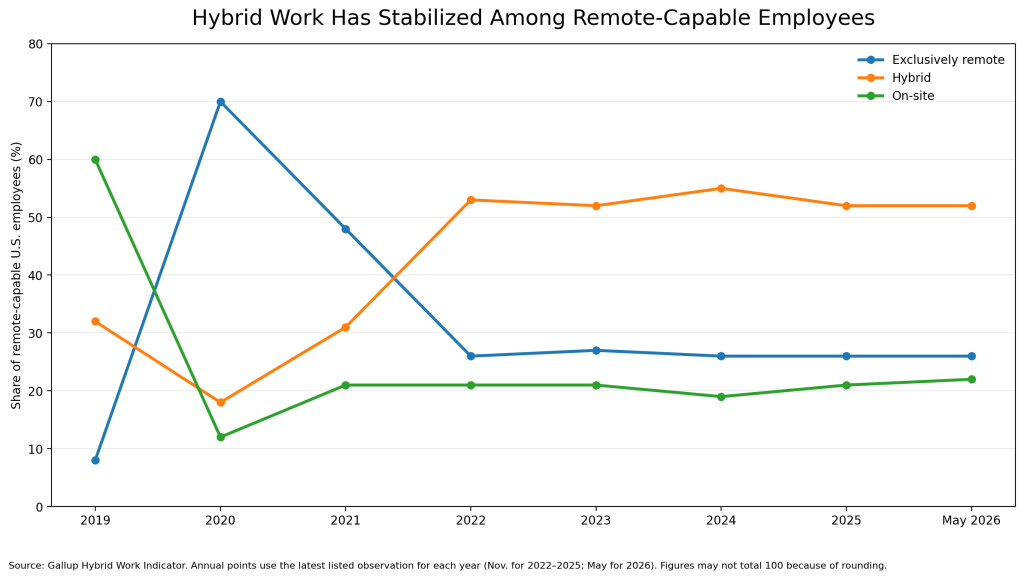
- 52% of remote-capable employees worked hybrid, while 26% worked fully remotely in May 2026.
- 87% of professional job postings in Robert Half’s Q2 sample required full-time on-site work.
- Remote postings rose 22% quarter over quarter in FlexJobs’ Q2 database.
Those figures seem to contradict each other. They do not. They reveal two different labor markets.
Remote work did not die. It settled!
WFH Research found that about 26% of paid full days were worked from home in July 2026. That share sits far below the pandemic peak, but it remains dramatically higher than the pre-pandemic level. Employer plans have also stayed near 1.3 to 1.5 home-working days per week since mid-2022. This pattern shows stability, not collapse.
Gallup tells a similar story among people who can work remotely. In May 2026, 52% worked hybrid, 26% worked exclusively remotely, and 22% worked on-site. These shares barely changed during the previous year. Hybrid work has not marched forward, but it has not retreated meaningfully either.
This is the first big lesson from the remote work trends 2026 data. Headlines track announcements. Workforce data tracks what people actually do. The two stories often move in different directions.
The flexibility gap is getting wider
Here is where the story changes.
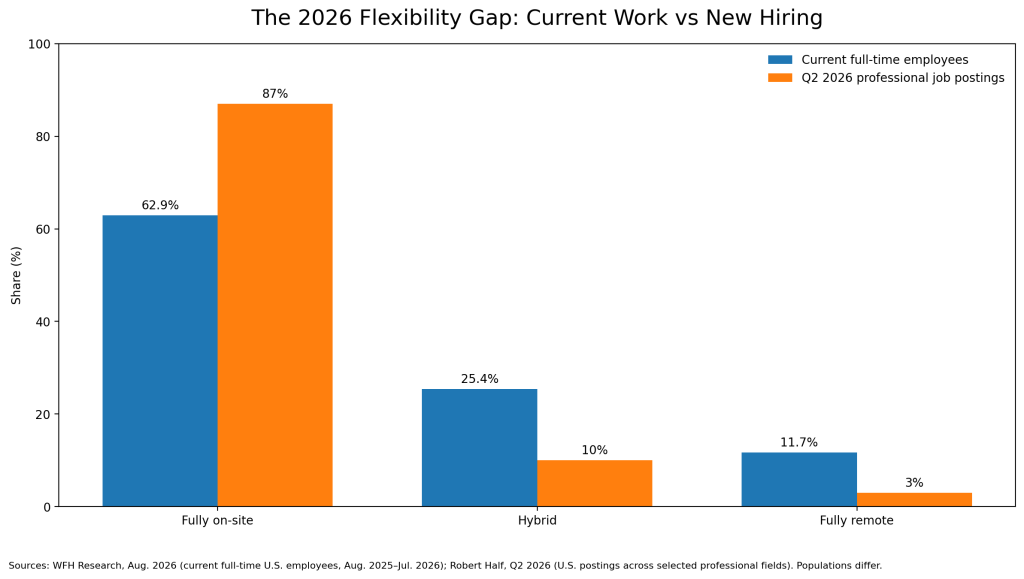
WFH Research found that 62.9% of full-time employees worked fully on-site over the previous year. About 25.4% followed hybrid schedules, while 11.7% worked fully from home. However, Robert Half found a much tougher market for people seeking a new role. In its Q2 2026 sample of professional job postings, 87% were on-site, 10% were hybrid, and only 3% were fully remote.
These studies cover different worker groups and job categories, so we should not treat them as a direct national comparison. Still, the contrast matters. Existing employees may keep flexibility that companies no longer offer to new hires.
That creates a new kind of workplace inequality. Tenure, seniority, industry, and bargaining power now shape who gets flexibility. Remote work has started to resemble a premium benefit rather than a default option.
This also explains why the future of remote work feels secure to some people and almost unreachable to others. A senior product manager with a proven record sees one market. A recent graduate searching for a first role sees another.
Hybrid won the practical argument
Fully remote work still matters, but hybrid has become the center of gravity. Gallup says six in ten remote-capable employees prefer a hybrid arrangement. Only a small minority want to work on-site full time.
The appeal feels human, not ideological. Hybrid workers value better work-life balance, more efficient use of time, less fatigue, greater freedom, and higher productivity. They also value office days for relationships, manager conversations, collaboration, and faster trust-building.
That balance explains why rigid policies often frustrate teams. People do not reject offices. They reject pointless attendance. A commute makes sense for mentoring, planning, creative work, or relationship-building. It feels wasteful when someone travels across a city to sit on video calls all day.
The best hybrid systems will stop counting presence as performance. They will give office time a clear purpose.
Remote hiring now rewards experience and AI fluency
The latest remote work hiring trends 2026 show a market that has become both smaller and more strategic.
FlexJobs reported a 22% quarter-over-quarter rise in remote postings during Q2 2026. Computer and IT roles more than doubled, while engineering, operations, and administrative categories grew by more than 30%. Yet 65% of those remote postings targeted experienced professionals.
Robert Half found the same seniority advantage from another angle. Senior-level postings offered hybrid or remote options in 16% of roles. That share fell to 13% for mid-level jobs and 10% for entry-level roles.
The wider labor market also favors experience. Indeed found that senior-level postings rose 14.7% year over year by May 2026, while entry-level postings fell 7.5%. LinkedIn also reported that U.S. jobs requiring AI literacy grew 70% year over year.
Together, these numbers point toward a clear strategy. Remote candidates need to show evidence, not just enthusiasm. Portfolios, measurable outcomes, strong written communication, independent decision-making, and AI fluency now carry more weight.
For younger workers, this creates a frustrating loop. Employers want remote-ready experience, but junior employees need opportunities to build it. Smart companies will solve this through structured hybrid onboarding, mentorship, and documented workflows rather than shutting entry-level workers out.
Your industry may decide more than your employer
National averages hide a huge divide.
In June 2026, 52.5% of workers in financial activities teleworked for some or all hours. Information followed at 47.2%, while professional and business services reached 41.8%. At the other end, leisure and hospitality reached only 7.7%, transportation and utilities 10%, and construction 10.2%.
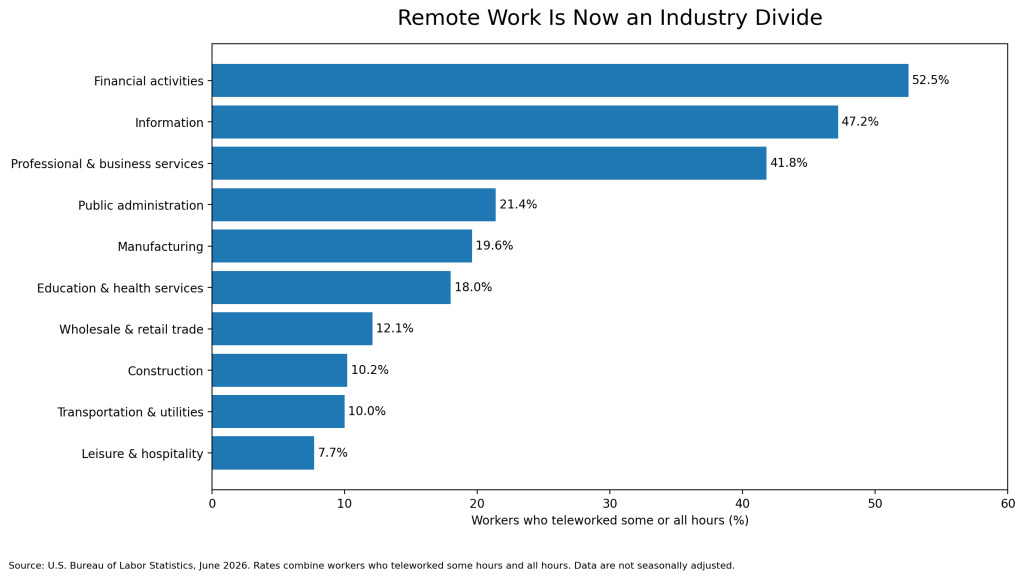
This gap will shape the next phase of remote work trends 2026. The debate often sounds universal, but remote work remains a privilege of task design. A software engineer, accountant, marketer, doctor, teacher, warehouse worker, and hotel manager cannot follow the same location policy.
The better question is not, “Does remote work work?” It is, “Which tasks need a place, which need people together, and which need uninterrupted focus?”
Return-to-office pressure will continue, but so will resistance
Corporate policy tightened in 2026. Microsoft began a three-day office requirement for many employees, while Stellantis pushed white-collar teams in the United States and Europe toward full-time office attendance.
Yet market pressure still protects flexibility. Indeed found that 16.9% of UK job postings mentioned remote or hybrid work by the end of June, close to a record high. The World Economic Forum also estimates that global digital jobs that people can perform remotely could reach 92 million by 2030.
This tension will define the future of remote work. Large companies may tighten rules, while smaller firms use flexibility to compete for talent. Some employers will hire globally. Others will demand local attendance. Workers will move between these systems based on life stage, leverage, and opportunity.
What should workers and employers do next?
Workers should treat flexibility like any other career advantage. Build skills that travel well. Document results. Learn to communicate decisions clearly. Use AI to improve output, but keep human judgment visible. During interviews, ask how teams use office days, not simply how many days they require.
Employers should design around outcomes. Set clear response times, documentation standards, meeting rules, and ownership. Bring people together for work that benefits from proximity. Protect focused work from constant calls. Most importantly, avoid rewarding visibility over contribution.
The strongest remote work hiring trends 2026 will favor companies that offer clarity. Candidates can accept strict office schedules when the reason makes sense. They can also thrive remotely when leaders create trust, structure, and real accountability.
Final Thoughts
Remote work did not defeat the office, and the office did not defeat remote work. The workplace split into several models, each serving different people and tasks.
The winners will not obsess over where work happens. They will decide when presence adds value, when distance improves focus, and how technology can support both. That is the real future of remote work in 2026: less hype, more choice, tougher competition, and a growing premium on trust.