Remote work statistics for 2026 tell a calmer story than the headlines. Return-to-office mandates made the news all year, yet the share of Americans working from home has barely moved. About one in five US workers teleworked in March 2026, and roughly a quarter of all paid workdays still happen at home.
What has changed is how people work remotely. Hybrid is now the default for desk jobs, office days are planned around being seen, and work is creeping into weekends. Below are the numbers that matter, each from a named 2026 source, and what they mean if you work remotely or run a remote team.
Remote Work Statistics 2026 at a Glance
| Statistic | Number | Source |
|---|---|---|
| US workers who teleworked (March 2026) | 22.6% | BLS |
| Paid workdays done from home (July 2026) | About 26% | Stanford SWAA |
| Full-time employees: fully remote / hybrid / on site | 12% / 26% / 62% | Stanford SWAA |
| Remote-capable employees working hybrid | 52% | Gallup |
| Remote-capable employees working fully remote | 26% | Gallup |
| Office attendance among knowledge workers | 65%, up from 63% | Owl Labs |
| Employees who do some work on a typical Sunday | 74% | Owl Labs |
| Workers whose ideal job is fully remote | 58% | FlexJobs |
| Workers who say nothing would bring them back full time | 30% | FlexJobs |
| Finance and insurance workers who telework | 59% | BLS |
How many people work remotely in 2026?
About one in five. The US Bureau of Labor Statistics found that 22.6% of workers teleworked in March 2026, and the rate stayed between 21.5% and 23.0% over the year before (BLS). That is a remarkably flat line for a year full of office mandates.
The BLS numbers also show who works from home:
- Women telework more than men: 24.9% vs 20.5%.
- Ages 25 to 54 have the highest rate at 25.1%. Workers aged 16 to 24 are at just 6.7%, mostly because early-career jobs are more often on site.
- Asian workers have the highest rate (31.1%), followed by white (23.2%), Black (16.1%), and Hispanic workers (13.1%).
The Stanford-led Survey of Working Arrangements and Attitudes (SWAA) measures something slightly different: the share of all paid workdays done from home. It found about 26% of paid days in July 2026 were work-from-home days. The researchers call that a jump equal to almost 40 years of pre-pandemic growth (WFH Research, September 2026).
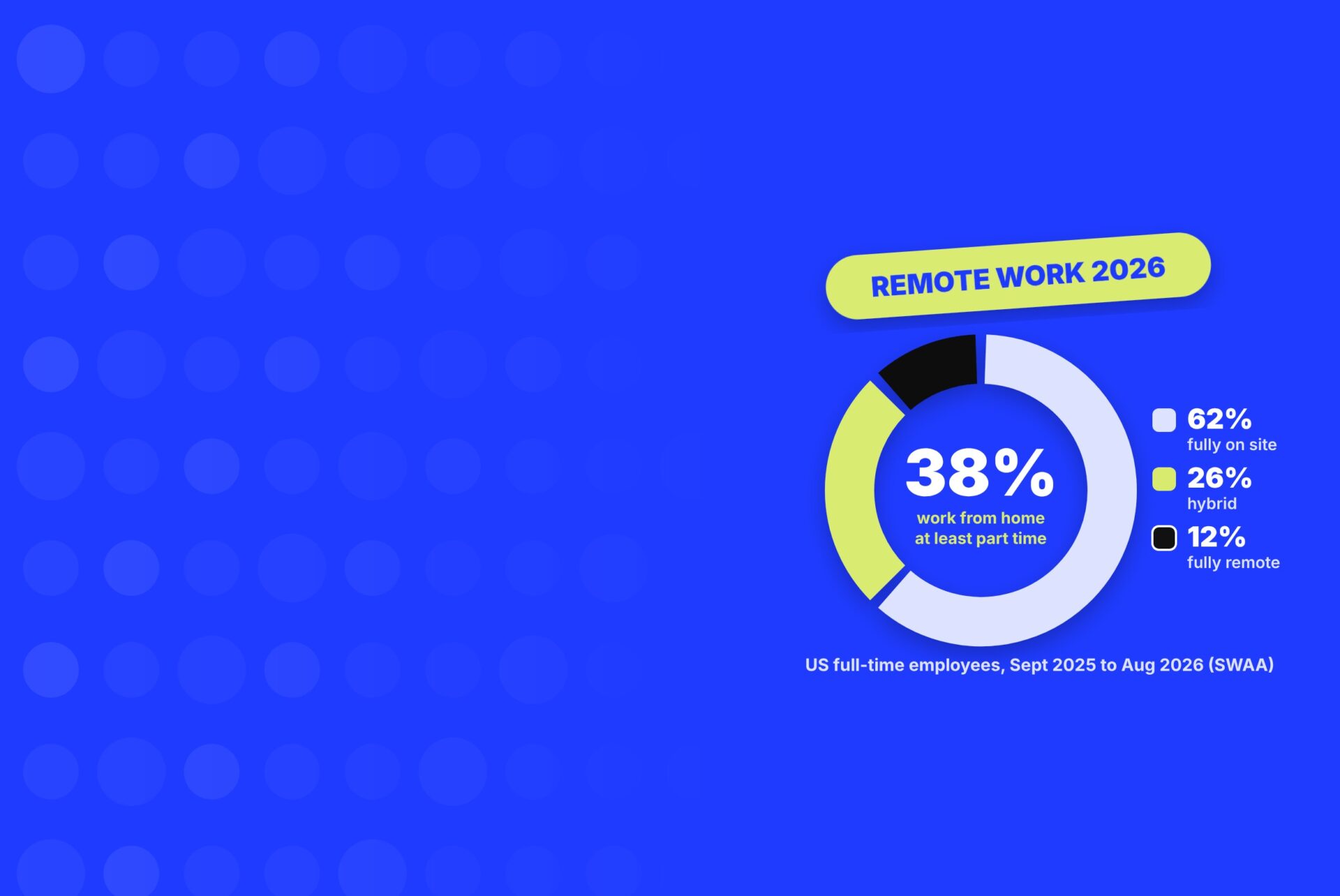
Among full-time employees over the past year (September 2025 to August 2026), SWAA counts:
- 12% fully remote
- 26% hybrid
- 62% fully on-site
So most people still go to a workplace every day. Remote work is concentrated in desk jobs, and that’s where the trend lines get interesting.
Hybrid Work Statistics: The Default for Desk Jobs
Gallup tracks employees whose jobs can be done remotely. In May 2026, that group split like this (Gallup):
- 52% hybrid
- 26% exclusively remote
- 22% fully on site
Hybrid has held at about 52% since 2022. Expectations match: 52% expect to stay hybrid long term, 25% expect to stay remote, and 23% expect to be on site.
Preferences lean further toward home. When Gallup asked in November 2025, 61% wanted hybrid, 33% wanted fully remote, and only 6% wanted to be on site every day. Yet only 11% of employees work on teams that set their hybrid policy together, so most schedules are still handed down rather than agreed.
How people use office days is shifting, too. Owl Labs’ 2026 State of Hybrid Work report found 48% of employees have picked specific office days to be seen by senior leaders or clients, or plan to. Owl Labs calls these “billboard days” (Fortune). The office is becoming a stage as much as a workplace.
Return to Office Statistics: Mandates vs Reality
Office attendance is rising, but slowly. Owl Labs puts in-office attendance among US knowledge workers at 65% in 2026, up from 63% a year earlier. A two-point gain is a long way from “everyone is back.”
Why do employees think the mandates exist? In the same survey:
- 76% say leaders want visibility and oversight
- 74% say productivity and collaboration
- 71% say client service and company culture
For most workers, policies haven’t actually tightened. In FlexJobs’ 2026 survey of 4,451 US workers, 76% said their employer had not increased in-office requirements. Of the 24% whose company is moving toward more office time, only 17% got a clear plan; 7% were told nothing.
Employer plans have also been steady for years. SWAA finds employers plan for about 1.3 to 1.5 work-from-home days a week, close to what people actually do. What workers want is only about half a day more. The return-to-office fight, in other words, is mostly over one afternoon a week.
Remote jobs 2026: which industries work from home most
Remote work depends far more on your industry than on your employer’s latest memo. The BLS breakdown for June 2026 shows the spread (BLS):
| Industry | Teleworked at all | Teleworked all hours |
|---|---|---|
| Finance and insurance | 59.0% | 31.7% |
| Professional and technical services | 55.8% | 32.1% |
| Information | 47.2% | 25.1% |
| Real estate | 37.0% | 16.0% |
| Wholesale trade | 21.6% | 9.7% |
| Public administration | 21.4% | 7.2% |
| Manufacturing | 19.6% | 8.0% |
| Health care and social assistance | 17.8% | 9.2% |
| Retail trade | 10.3% | 5.0% |
| Construction | 10.2% | 3.5% |
| Accommodation and food services | 3.9% | 1.6% |
If you’re hunting for remote jobs in 2026, finance, consulting, tech and media are where the odds are best. Education matters as well: SWAA finds graduate-degree holders spend 32.7% of their workdays at home so far in 2026, against 19.1% for those with a high school education or less.
What Remote Workers want in 2026
Asked for their ideal setup, FlexJobs respondents chose 58% fully remote, 38% hybrid, and just 4% fully in office. Over half (53%) say they get more done remotely, and 47% say fully remote work is best for their mental health.
What would get them back to a desk five days a week? Not much:
- 30% would return for a four-day workweek
- 30% say nothing would bring them back
- 18% would do it for a 15% raise
- 12% would do it for unlimited paid time off
Owl Labs adds a sharper number: 47% of workers would give up 10% or more of their salary to keep flexible hours. When Owl Labs asked what would bring people in more often, pay came first (39%), followed by being allowed to choose their own office days (29%).
The pattern is clear. People care less about where they work than about control over when they work. Flexibility now competes with salary, not with free lunch.
The Hidden Costs of Flexible Work
Flexibility has a catch: work spreads into every hour you leave open. Owl Labs found that 74% of employees do some work on a typical Sunday, and 21% say it adds up to a full or nearly full workday.
Meetings are part of the problem. In the same report, 38% of employees report meeting fatigue. They blame meetings that run long (45%), too many meetings (41%), and meetings that should have been emails (39%). Hybrid calls waste time before they even start: the average meeting takes 6 minutes to get going, and 66% of people lose time to technical problems.
AI cuts both ways. 82% of workers use AI at work, and 69% say it makes them more productive. But 62% say it has raised how much they’re expected to finish in a day, and 46% say it has slowed them down at times.
What these Numbers mean for You
If you work remotely or lead a remote team, the data points to four practical moves:
- Treat hybrid as permanent. It has sat at about 52% of remote-capable workers for four years. Plan tools, budgets, and careers around it rather than waiting for a full return.
- Make your office days count. If people come in to be seen, put the meetings that need a room on those days and keep focused work for home.
- Protect your weekends on purpose. With 74% working on Sundays, “flexible” quietly becomes “always on.” Set a hard stop and tell your team what it is.
- Get time zones right. Distributed teams lose hours to scheduling across cities. This week is a good example: Europe set its clocks back on October 25, and the US does it on November 1, so for one week the gap between New York and London is an hour shorter than usual. Our free TimeBridge time zone planner shows everyone’s local time side by side, and our guide to daylight saving time meetings in 2026 explains which meetings move.
For tools that make remote work smoother, see our list of the 11 best productivity apps for remote workers. For the bigger picture, read the future of remote work.
Frequently Asked Questions
What percentage of people work remotely in 2026? In March 2026, 22.6% of US workers teleworked for at least some of their hours, according to the BLS. Among full-time employees, Stanford’s SWAA counts 12% as fully remote and 26% as hybrid.
Is remote work declining in 2026? No. The BLS telework rate stayed between 21.5% and 23.0% over the past year. Office attendance among knowledge workers rose only two points, from 63% to 65%, according to Owl Labs.
Is hybrid more common than fully remote work? Yes, about twice as common. Gallup finds 52% of remote-capable employees work hybrid and 26% work fully remote.
Which industries have the most remote jobs? Finance and insurance (59%), professional and technical services (55.8%), and information (47.2%) had the highest telework rates in June 2026, according to the BLS.
Do remote workers work more on weekends? Many do. Owl Labs found 74% of employees do some work on a typical Sunday, and 21% put in a full or nearly full day.
The Bottom Line
Remote work in 2026 is stable, not shrinking. About a fifth of US workers telework, roughly half of desk workers are hybrid, and the return-to-office push has moved attendance by only a couple of points. The new challenge is keeping flexible work from spilling into evenings, weekends, and badly timed meetings across time zones.
Working with people in other cities? Plan your next meeting with TimeBridge. It’s free and works in your browser.
Sources: BLS, March 2026, BLS, June 2026, WFH Research (SWAA), September 2026, Gallup, Owl Labs 2026 via Fortune and 01net, FlexJobs.
Checked October 28, 2026.