Every autumn, daylight saving time meetings cause the same headache: invites that worked fine all summer quietly turn wrong. Nobody edited them. The clocks moved.
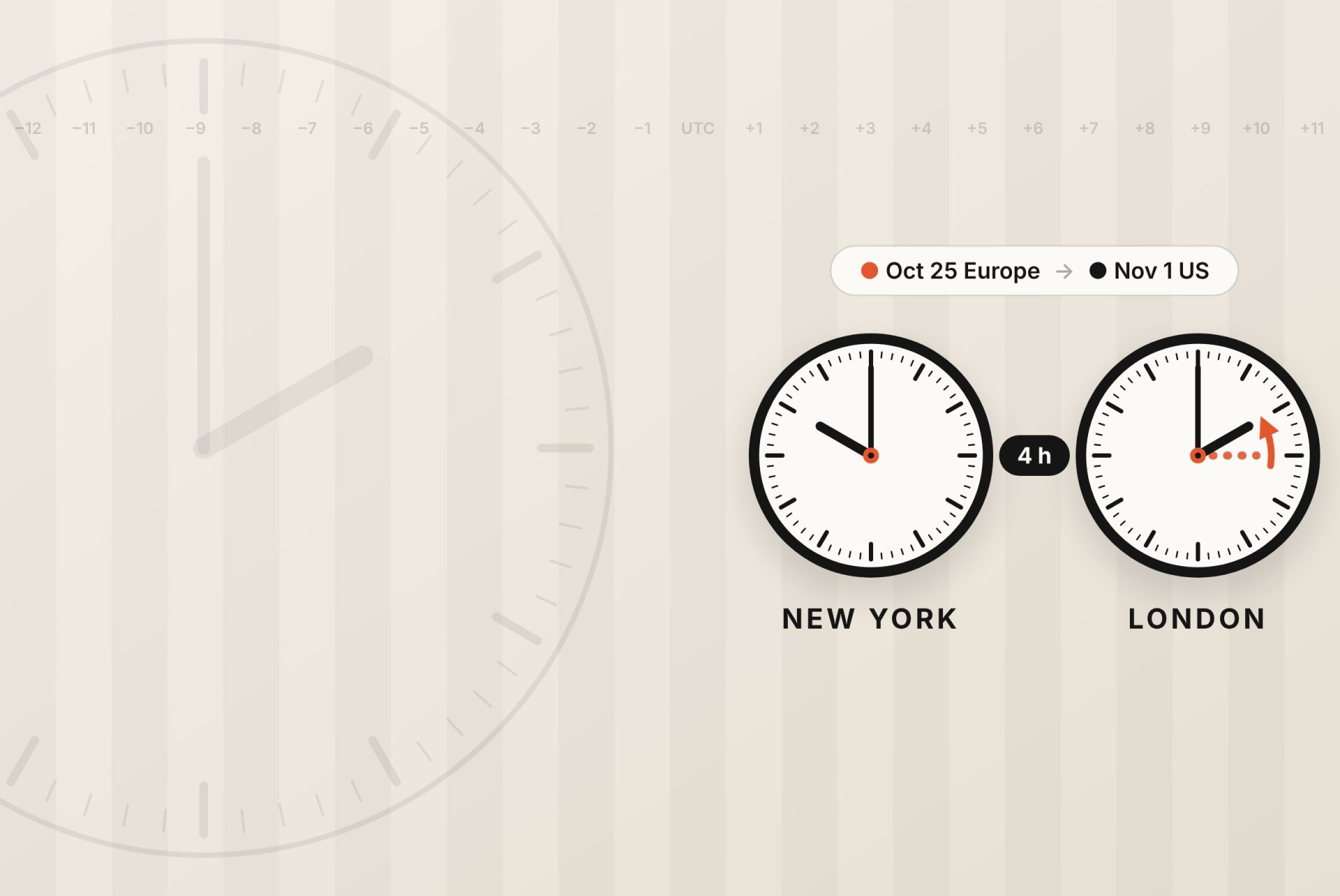
In 2026, the trouble comes in two waves. Europe moves its clocks back on Sunday, October 25. The United States and Canada follow a week later on Sunday, November 1. For the seven days in between, the usual gap between New York and London is four hours instead of five. Your 10 a.m. call with the London team now starts at 2 p.m. their time, not 3 p.m. Some people turn up an hour early, some an hour late, and some not at all.
If you work with people in other countries, this guide shows exactly what shifts, who gets caught out, and how to check every recurring meeting in a couple of minutes with a free time zone meeting planner.
Daylight saving time 2026: the dates that matter
Daylight saving time (DST) is the practice of moving clocks forward one hour in spring and back one hour in autumn. Not every country does it, and those that do don’t change on the same day. That mismatch is what breaks global meetings.
| Region | 2026 change | What happens |
|---|---|---|
| European Union and UK | Sunday, October 25, at 01:00 UTC | Clocks go back one hour. The UK moves from BST to GMT; Central Europe from CEST to CET. |
| United States and Canada (most areas) | Sunday, November 1, at 2:00 a.m. local time | Clocks go back one hour. EDT becomes EST, PDT becomes PST. |
| Southeast Australia (Sydney, Melbourne, Hobart, Adelaide) | Started Sunday, October 4 | Clocks went forward one hour. Sydney is now on AEDT, UTC+11. |
| New Zealand | Started Sunday, September 27 | Clocks went forward one hour, to NZDT, UTC+13. |
| No change | All year | Pakistan, India, the Philippines, the UAE, China, Japan, most of Mexico, Arizona and Hawaii keep the same time. |
The US date is fixed by federal law as the first Sunday in November, which makes November 1 the earliest it can fall. Europe always changes on the last Sunday of October. When those two Sundays are a week apart, as they are this year, you get a full working week of mismatched offsets.
How common meeting times shift between October 25 and November 1
The table shows how far ahead the first city is in each period. Most pairs change once. US–Europe pairs change twice, on October 25 and again on November 1.
| City pair | Until Oct 24 | Oct 25 – Oct 31 | From Nov 1 | Example: what shifts |
|---|---|---|---|---|
| London ahead of New York | 5 h | 4 h | 5 h | A 10 a.m. New York call lands at 2 p.m. in London for one week, then goes back to 3 p.m. |
| Berlin ahead of New York | 6 h | 5 h | 6 h | Same one-week squeeze for Paris, Madrid, Amsterdam and the rest of Central Europe |
| London ahead of Los Angeles | 8 h | 7 h | 8 h | An 8 a.m. LA call is at 3 p.m. in London that week, not 4 p.m. |
| Karachi ahead of London | 4 h | 5 h | 5 h | A 2 p.m. London check-in moves from 6 p.m. to 7 p.m. in Pakistan |
| Karachi ahead of New York | 9 h | 9 h | 10 h | A 9 a.m. New York stand-up moves from 6 p.m. to 7 p.m. in Pakistan |
| New Delhi ahead of New York | 9.5 h | 9.5 h | 10.5 h | A 9 a.m. New York call moves from 6:30 p.m. to 7:30 p.m. in India |
| New Delhi ahead of London | 4.5 h | 5.5 h | 5.5 h | A 9 a.m. London call moves from 1:30 p.m. to 2:30 p.m. in India |
| Manila ahead of New York | 12 h | 12 h | 13 h | A 9 p.m. Manila handover now catches New York at 8 a.m., not 9 a.m. |
| Dubai ahead of London | 3 h | 4 h | 4 h | A 9 a.m. London call moves from noon to 1 p.m. in Dubai |
| Sydney ahead of London | 10 h | 11 h | 11 h | A 5 p.m. London call is now 4 a.m. in Sydney, not 3 a.m. |
| Sydney ahead of New York | 15 h | 15 h | 16 h | A 5 p.m. New York call moves from 8 a.m. to 9 a.m. in Sydney |
Two patterns are worth noticing:
- If you live somewhere without DST (Pakistan, India, the Philippines, the UAE), your local clock never moves, but your meetings with Europe shift on October 25 and with North America on November 1. You get two disruptions, a week apart.
- If you are in the US or Europe, the week of October 25 is the odd one out. Recurring calls across the Atlantic will feel an hour off, then snap back.
Who gets caught out
Calendar apps handle the clock change correctly for the person who created the meeting. The confusion happens everywhere else.
- Offshore and outsourced teams. A support team in Manila or a dev team in Lahore working US hours sees its shift start an hour later on November 1, with no change to local clocks.
- Anyone who said a time in a message. “Let’s do 3 p.m. your time” in Slack or WhatsApp doesn’t update itself. Calendar invites do; chat messages don’t.
- Meetings anchored to one city. A recurring invite set in New York time stays at 10 a.m. for New York. For everyone in Europe, it moves by an hour, twice a week.
- Freelancers with clients on three continents. Your client in Sydney moves forward on October 4, your client in London moves back on October 25, and your client in Chicago on November 1. That is three different offsets in one month.
- Shared deadlines. “5 p.m. Friday, New York time” means 2 a.m. Saturday in Karachi before November 1, and 3 a.m. after. If someone sets the deadline in their own head rather than on a calendar, it slips.
Your daylight saving time meetings checklist
Give this ten minutes before October 25.
- List your recurring cross-border meetings. Stand-ups, client calls, weekly syncs, handovers.
- Check which city each meeting is anchored to. In Google Calendar or Outlook, open the event and look at its time zone. That city’s clock is the one the meeting follows.
- Check the week of October 25 to 31 separately. For US–Europe meetings, this is a different week. Decide whether to keep the time for the US side or the European side, and tell people.
- Recheck everything for November 1. Teams in Asia, the Middle East, and Latin America feel the US change, even though their own clocks stay put.
- Rewrite times in plain messages. Anywhere you’ve written a time in chat, email, or a project tool, add both time zones, for example, “3 p.m. London / 10 a.m. New York”.
- Send one short heads-up. A two-line note to your team or clients (“US clocks change November 1, so our Tuesday call is now 7 p.m. for Karachi”) saves hours of confusion.
- Look at the next change in March. The US moves forward on March 14, 2027, and Europe on March 28, 2027. You’ll get the same two-week mismatch in spring.
How to check your meetings with TimeBridge
Doing time zone maths in your head is how meetings go wrong. TimeBridge is a free time zone meeting planner from What Works Next. It shows every city on one timeline, so you can see the overlap instead of calculating it. It runs in your browser, with no sign-up and no account.
- Add your cities. Type each country, city, or region into the search bar: for example, New York, London, Karachi, and Sydney.
- Compare the hours. Hover across the timeline to see what time it is in every location at once. Daylight saving is applied automatically using each location’s own rules, so you never adjust anything by hand.
- Pick a slot and send it. Click or drag across the hours that work for everyone. A Google Calendar icon appears; click it to create the event in the right time zone.
- Check again after each change. Open TimeBridge on Monday, October 26, and again on Monday, November 2. Your saved cities will still be there, because preferences are stored in your browser, and the overlap will reflect the new offsets.
Two settings help during clock-change weeks: switch to 24-hour format to avoid a.m./p.m. mix-ups, and turn on weekend highlighting to spot when a late-night call has slipped into someone’s Saturday.
Could the clocks stop changing?
Possibly, but not in time for this year.
- United States: The House passed the Sunshine Protection Act, which would make daylight saving time permanent, by 308 votes to 117 on July 14, 2026. It then stalled in the Senate, which went into recess without a vote and won’t return until after the November 3 midterm elections. So the bill can’t become law before November 1, and US clocks will fall back as planned. (LiveNOW from FOX, October 2, 2026)
- European Union: The European Parliament voted to end seasonal clock changes in 2019, but member states have never agreed on the details. The European Commission is running a new impact assessment due by the end of 2026, and Lithuania, which takes over the EU presidency in January 2027, wants to restart the debate. (LRT)
Even if one side stops changing its clocks, the other might not, so the offsets between countries would still move. Plan for both changes this autumn as scheduled.
Frequently asked questions
When does daylight saving time end in 2026? In the EU and UK, on Sunday, October 25, 2026 at 01:00 UTC. In most of the United States and Canada, on Sunday, November 1, 2026 at 2:00 a.m. local time.
Do the clocks go forward or back in October 2026? In Europe and North America, they go back one hour, so you get an extra hour that night. In southeast Australia and New Zealand, they already went forward on October 4 and September 27.
Why is the time difference between New York and London only four hours for a week? The UK leaves summer time on October 25, but the US doesn’t until November 1. For those seven days, London is four hours ahead of New York instead of five.
Do Pakistan and India observe daylight saving time? No. Pakistan stays on PKT (UTC+5) and India on IST (UTC+5:30) all year. Your local clock doesn’t change, but your meeting times with Europe and North America do.
Will my calendar meetings update automatically? Calendar events update for the time zone they were created in. If a meeting was set in New York time, people in other countries will see it move. Times written in chat or email never update, so recheck those yourself.
What is the time difference between New York and London in November 2026? Five hours, from November 1 onward. London is on GMT (UTC+0) and New York on EST (UTC−5).
Check your meetings before Sunday
The clock change takes seconds. Untangling a missed client call takes much longer. Open TimeBridge, add the cities you work with, and see this week’s real overlap in one view. It’s free, needs no sign-up, and adjusts for daylight saving time automatically.
Plan your next meeting with TimeBridge →